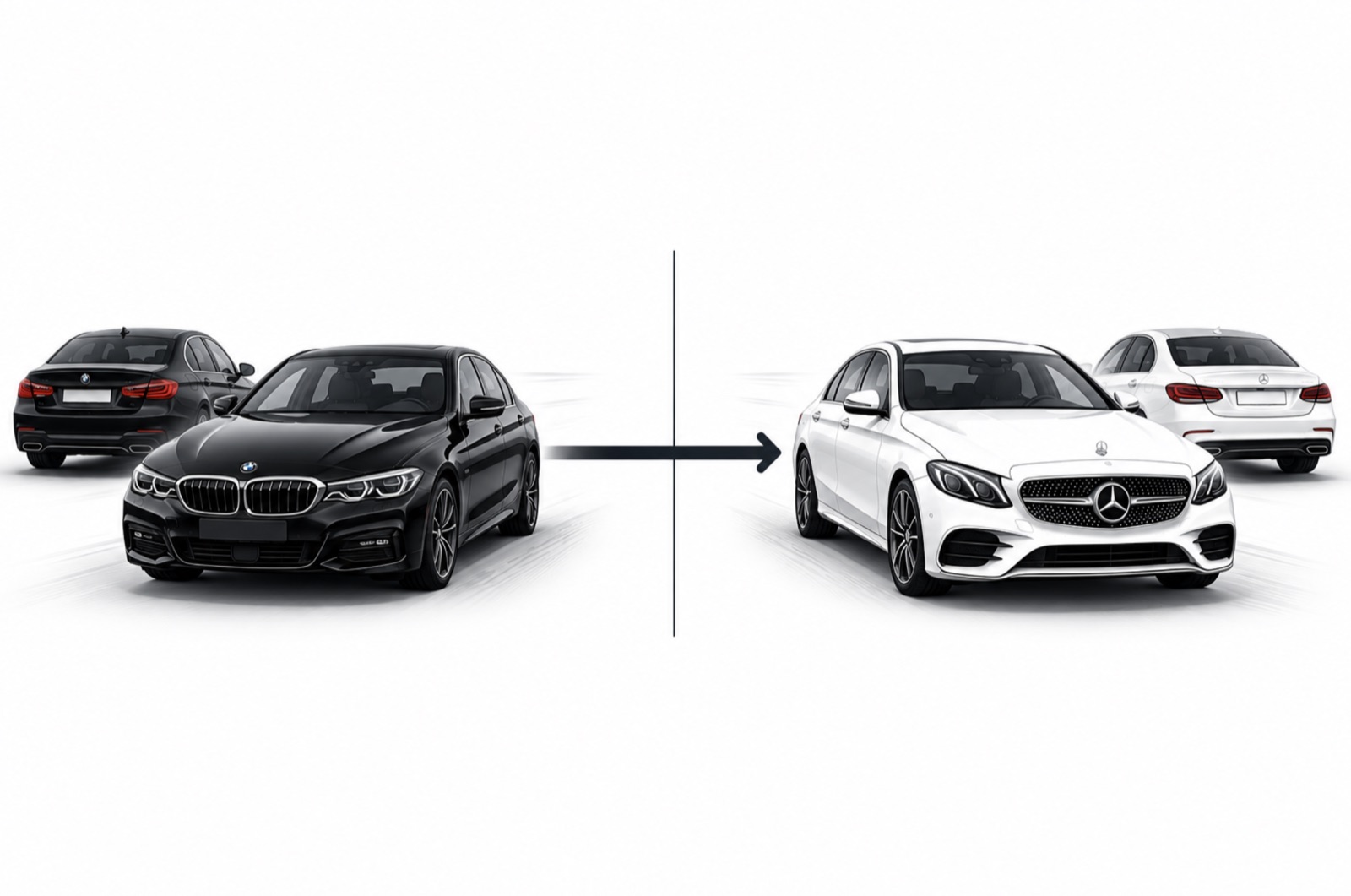
A trade-in is usually settled in the same conversation it started. The customer arrives with the registration of another marque, the salesperson cannot put a Mercedes configuration in front of them, and both agree on a follow-up. That follow-up often doesn’t happen, because the customer browses elsewhere in between.
What the tool does
From the data of a third-party vehicle — make, engine, body, equipment — it derives the matching Mercedes-Benz equivalent in 20 to 30 seconds: model, equipment packages, and a code for the official Mercedes configurator. The salesperson can adapt the proposal directly, one class up or a different engine, without losing the equipment that carried over. At the end, the customer leaves with a short code that opens the same configuration at home in the official Mercedes configurator.
What changes at the desk
Instead of „we’ll get back to you”, the salesperson says: „Here’s the configuration I see for you. Want an E-Class instead? Two clicks, the equipment carries over.” That moves the trade-in out of the waiting queue into a concrete next step. The expensive moment in the sales process isn’t the research time, it’s the break between first conversation and follow-up, and closing it lifts first-appointment conversion without investment in any other channel.
Where the AI would make mistakes if you let it
An AI proposing Mercedes packages can produce two kinds of error: a suggestion the catalogue doesn’t contain, or a combination that doesn’t fit together. We prevent both at two stages. Before the AI sees anything, we strip out the equipment that’s standard in every modern car, controlled by a curated list of about 75 keywords (ABS, tyre pressure, emergency call, first-aid kit and so on); seeing those items, the AI would try to find a Mercedes package for them and invent one. After the answer, we check the mirror: if the AI claims to have mapped a BMW detail to a Mercedes package but that detail wasn’t in the input, the claim is dropped silently.
What the configurator still rejects
Even a plausible selection isn’t necessarily one the real Mercedes configurator accepts. Some packages exclude each other — two design lines, for instance, that cannot be ordered together. This rule is only partly written down. It surfaces only when the configurator actually assembles the configuration and drops one. Our tool runs every selection through that exact check. What the configurator removes turns red on screen and is automatically deselected. The salesperson reads, in plain language: „Mercedes configurator did not accept this selection”, and carries on.
What the customer leaves with
The pipeline ends with a short alphanumeric code like „M7QPBZ82”. Entered at mercedes-benz.de, it opens the exact configuration in the official Mercedes configurator — the same application every customer knows from the Mercedes website. An important consequence follows: anything the tool suggests has been validated against the official configurator in the background, otherwise the code wouldn’t exist. We don’t build a parallel system with its own truth, only the bridge into the official one.
Conclusion
The filters in front of and behind the AI aren’t specific to the trade-in. The same approach holds anywhere Mercedes-Benz puts a configuration in front of a customer — from the showroom to the service appointment, from the online configurator to fleet offers. The AI doesn’t replace the configurator, it replaces the hour of searching that a human would otherwise spend. It does that reliably only when disciplined filters sit before and after.